

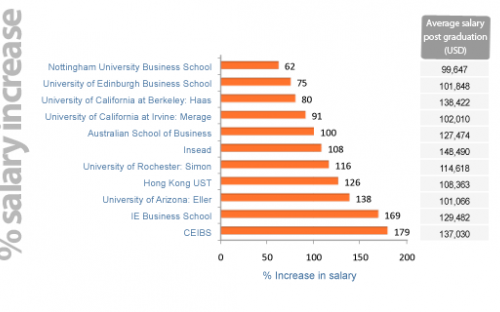


The weighted average salary appears to show how much an MBA costs relative to each school ranked across the world. However, when you look a little closer things aren’t what they seem.
Take the Indian School of Business (ISB): this year they saw a drop in weighted annual salary year on year, but a huge 21 percentage point increase in salary, which pushed them up to a high-flying 15th on the ranking table.
Blame the FT scoring system: the 20% weighting attached to a measure that has underlying interpretation issues is not the best way to decide a school's rank, as it can skew the results.
Some say the rise of ISB is an anomaly but who would bet against another school from India, or perhaps Russia, attaining similar status, ranking and profile in the next few years?
Also, any reduction in the level of salary increase of a school's alumni seem over-stated. For instance, HEC Paris, traditionally a popular European business school, dropped from 18th to 29th this year and a major reason for this was their annual salary increase figure dropping from 126 per cent in 2008 to “only” 103 per cent in the latest rankings.
Also, one may earn a substantial salary in London, New York or Paris but alumni from the same institutions who choose to work in places such as Singapore or Hyderabad, would be on significantly lower packages but would be better off given the difference in cost of living.
So in HEC Paris's case, a 23 per cent salary decrease for their alumni doesn't necessary mean that the status of one of France’s best business schools is wobbling.
Alumni certainly view their current remuneration as a measure of the success of their studies, but the FT’s use of weighted salary and percentage increase is a rather ambiguous measure.
The salary data in the FT ranking as a first port of call for many students, but caveat emptor – there’s more to the rankings – and to business schools - than just the salary.
Rob Read advises companies and business schools on marketing strategy and is director of Media Minds Global.
RECAPTHA :
40
35
2c
08